
Mofongo Origin: Is It Dominican, Puerto Rican, or Both?

Mofongo Origin: Is It Dominican, Puerto Rican, or Both?
Reported by Alex Tabar and Erika Morillo. Expanded and updated by the COCINA editorial team with additional history, cultural context, and recipe detail.
Put a plate of mofongo in front of a table that includes both Puerto Rican and Dominican family members, and the debate starts before the fork does. From the heart of the Caribbean, mofongo is a dish that entices the palate just as easily as it reignites the mofongo origin debate that's almost as old as the dish itself. At its simplest, mofongo is fried green plantains, mashed with garlic and a mix of meat or seafood, usually served alongside fried meat and broth — humble ingredients that somehow start family arguments at every table where it lands.
Mofongo is undoubtedly delicious, but like the Pisco Sour rivalry between Peru and Chile, its origin gets disputed constantly — Puerto Rico and the Dominican Republic each claim the dish as their own, and both have a case worth hearing. Which raises the more interesting question: not just where is mofongo from, but why do two countries with such distinct culinary identities both feel this strongly about a bowl of mashed plantains?
What Is Mofongo, Exactly?
Mofongo starts with green plantains, fried until the outside turns golden and the inside softens just enough to mash. Traditionally, it's pounded in a wooden mortar called a pilón, together with garlic, salt, and pork cracklings or bacon, until it holds together like a dense, savory dumpling. The mash gets shaped into a ball or pressed into a bowl, then served with broth for dipping, a side of fried meat, or built directly around a filling of shrimp, chicken, or stewed beef. It's not a light dish, and it was never meant to be — mofongo was built to fill you up, the same way a good bowl of rice and beans is built to fill you up.
So, Is Mofongo Dominican or Puerto Rican?
Mofongo's real story starts long before Puerto Rico or the Dominican Republic existed as we know them, with a West African dish called fufu. Fufu is believed to have originated among Akan communities in what's now Ghana, made by pounding starchy vegetables like plantain, cocoyam, or yam into a smooth, dense mass — the name itself comes from the Twi word for “white,” a nod to the pale color of the pounded root. Fufu traveled to the Caribbean the way so much of the region's food did: carried, remembered, and remade by enslaved West and Central Africans, who kept the technique alive using whatever starches were available in a new place.
In Puerto Rico, that technique fused with Taíno root-mashing traditions and Spanish pantry staples — pork, garlic, and olive oil folded into a dish that was, by the mid-1800s, distinct enough to have its own name and its own written recipe. “Mofongo criollo” appears in El Cocinero Puerto-Riqueño, Puerto Rico's first cookbook, published in 1859, calling for green plantains mashed with veal, hen, garlic, and oregano. Even the word “mofongo” has African roots, likely from the Kikongo phrase mfwenge-mfwenge, meaning “a great amount of anything at all” — which, frankly, tracks for a dish nobody has ever finished a small portion of.
So is mofongo Dominican? The Dominican Republic's own fufu descendant is mangú — mashed green plantains, usually topped with sautéed red onions and eaten for breakfast alongside eggs, cheese, and fried salami in a combination Dominicans call los tres golpes (“the three hits”). Mofongo itself, under that name, entered Dominican kitchens later, largely through the wave of Dominicans who left during and after the Trujillo dictatorship and settled in Puerto Rico and New York City, where the dish was already firmly established. The first known Dominican cookbook reference to mofongo shows up decades later, in the 1962 edition of Amanda Ornes's Cocina Criolla. None of that makes Dominican mofongo any less legitimate on a plate today — Dominican restaurants across the diaspora serve their own excellent versions, the same way Dominican churrasco proves the island's food identity extends well past mofongo — but the documented paper trail points to Puerto Rico as the place the dish, and its name, took shape first.
Both islands, in other words, are right — just about different parts of the timeline. The same root technique also shaped Jamaica's bammy and Cuba's own fufú de plátano, part of a much larger Caribbean food inheritance built on plantains, root vegetables, and resourcefulness. This was never really a two-country property dispute. It's a shared debt to the West and Central African hands that carried the technique across an ocean in the first place.
Mofongo's Many Variations
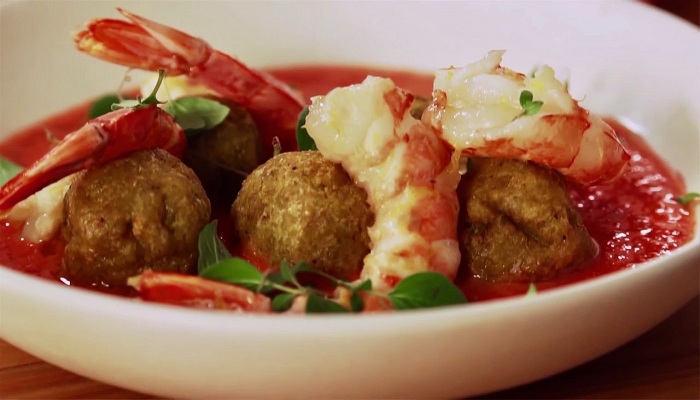
Green plantains are endlessly adaptable, which is how mofongo ended up with so many regional and personal versions. Mofongo de chicharrón swaps in fried pork cracklings for extra crunch. Mofongo de camarones goes the seafood route, usually built around garlic shrimp. Mofongo relleno turns the mashed plantain into more of a vessel than a side, hollowed out or shaped into a bowl and filled with stewed beef, chicken, or seafood in sauce, with a drizzle of that same sauce over the top before serving. Some cooks add a few slices of cooked bacon straight into the mash, oil and all, for a version that's arguably its own category. There's no single correct mofongo — there's just the version your family swears is the only real one.
The Mofongo Recipe Worth Learning by Heart
Mofongo
Serves 2–3
Ingredients
- 3 green plantains, peeled and cut into 1-inch rounds
- Vegetable oil, for frying
- 4–5 garlic cloves, minced or mashed
- Salt, to taste
- 2–3 slices cooked bacon, chopped, plus a bit of the rendered fat (optional)
- Broth (chicken or pork), for serving
- Cooked meat or seafood of choice — pork cracklings, garlic shrimp, or stewed beef — for topping or filling
Directions
- Fry the plantain rounds in hot oil until golden and tender, about 5–7 minutes. Drain on paper towels.
- While still warm, transfer the fried plantains to a pilón (wooden mortar) or a large bowl.
- Add the garlic, salt, and bacon, along with a bit of its fat if using. Mash together until combined but still a little textured — mofongo shouldn't be perfectly smooth.
- Press the mixture into the mortar or a round bowl to shape it into a dome, then invert onto a plate.
- Serve immediately with warm broth on the side, plus your choice of fried meat, garlic shrimp, or stewed beef either alongside or stuffed into the center for mofongo relleno.
Pro tip: Mash the plantains while they're still hot — they firm up fast, and a cold mash won't hold its shape.
Make it garlicky. Make it with bacon. Make it stuffed with shrimp swimming in criolla sauce, or keep it simple with nothing but broth on the side. However it lands on your plate, mofongo carries the same inheritance every time — West African technique, Taíno ingredients, Spanish pantry staples, and generations of Puerto Rican and Dominican cooks who each made it their own. That's a lot of history to fit in one mortar. For more of it, plated a hundred different ways, there's a whole shelf of Latin recipes waiting. Pass the garlic.